
How AI is Orchestrating Your Daily Tech Without You Even Noticing
Think about the last time you blindly trusted a map app to reroute you around a traffic jam, or when your streaming service served up a bizarrely perfect movie recommendation. It’s easy to dismiss these as simple algorithms, but that’s like calling the Sistine Chapel a “decent paint job.” What we’re experiencing is the quiet infiltration of sophisticated Artificial Intelligence, moving from a novelty to the central nervous system of our daily technology. We’re no longer just using tech; we’re in a constant, subtle dialogue with it. This shift isn’t about clunky robots serving coffee; it’s about your devices developing a form of context-aware intuition. They are evolving from tools that execute commands to partners that anticipate needs, a transition so seamless we often fail to recognize the digital maestro conducting the symphony of our daily lives.

So, how is this digital maestro earning its keep? Let’s peek behind the curtain. The most profound change is the move from reactive search to proactive assistance. Google’s Search Generative Experience (SGE) is a prime example. Instead of just giving you ten blue links to sift through, it uses a massive language model to synthesize information, answer complex questions directly, and even suggest follow-up queries you hadn’t considered. It’s the difference between being handed a phonebook and having a well-read librarian summarize the exact page you need. Similarly, the magic of Spotify’s “Discover Weekly” or Netflix’s top-row isn’t just collaborative filtering anymore. It’s deep learning analyzing the acoustic features of the music you love or the cinematic DNA of the shows you binge, connecting dots no human programmer could ever manually code. The logic is simple: reduce the friction between your intent and your satisfaction, and you create a product that feels less like a machine and more like an extension of your own brain.
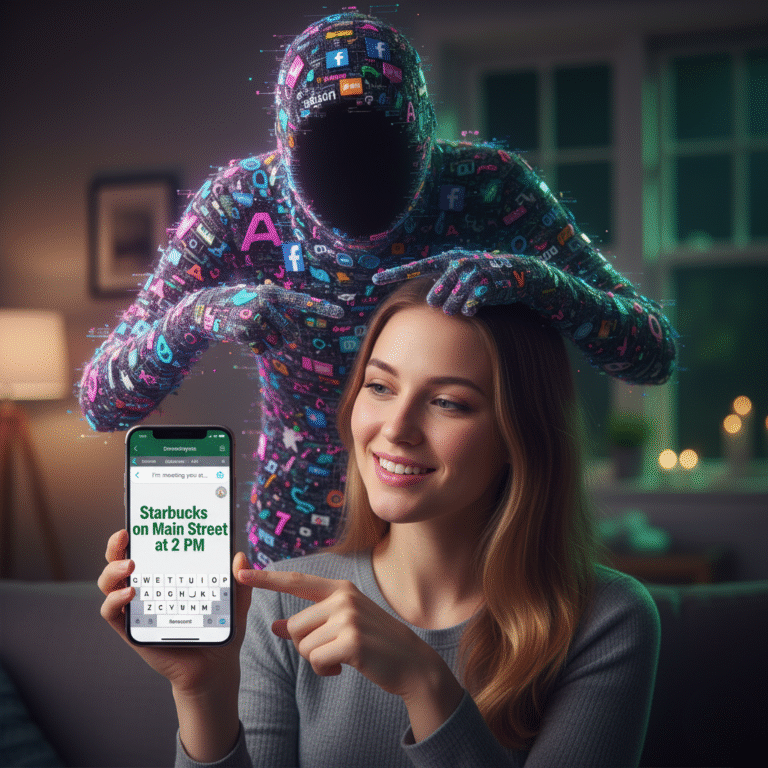
Of course, with a companion this perceptive, things can get a little… personal. The same AI that powers the uncanny accuracy of your Gmail’s auto-complete is also the engine behind the targeted ad that seems to have eavesdropped on your dinner conversation. This is the classic “AI Privacy Paradox.” We revel in the convenience but squirm at the implication. Experts like Dr. Kate Crawford, in her book “Atlas of AI,” articulate this tension brilliantly, pointing out that these systems are built on a foundation of our data the raw material extracted from our daily digital exhaust. The logic is a Faustian bargain: we trade slices of our digital anonymity for hyper-personalized convenience. The humor here is darker, found in the universal experience of muttering “okay, that’s creepy” when your phone serves you an ad for that exact brand of artisanal pickles you just mentioned aloud. It’s a reminder that our smartest tech is also our most gossipy neighbor.
Looking ahead, the line between tool and teammate will blur beyond recognition. We’re moving towards what experts like Mustafa Suleyman (co-founder of DeepMind) term “AI as a companion.” Imagine your smartphone not just setting a morning alarm, but cross-referencing your calendar, sleep data, and local traffic to gently nudge you with, “You have a big presentation at 10 AM, and the roads are a mess. I’ve moved your wake-up time 15 minutes earlier, and your coffee machine will start brewing at 7:02.” The logic is a shift from episodic commands to a continuous, ambient relationship. The journey of AI in our daily tech is no longer about building a smarter calculator; it’s about weaving an invisible, intelligent fabric into the background of our existence. It’s a wonderful, slightly unnerving, and utterly transformative journey, and whether we’ve realized it or not, we’re all already along for the ride.
The Unseen AI Revolution in Your Pocket and Home
If your smartphone from 2015 could time-travel to today, it would be utterly bewildered. It would see you casually asking a slab of glass and metal to tell you a joke, to identify a plant from a photo, or to summarize a 20-page document in three bullet points. The fundamental shift in our daily tech isn’t a new feature; it’s a new language. We’ve transitioned from a paradigm of menus and buttons to one of natural language and context. This isn’t just an upgrade; it’s a philosophical overhaul. Our devices are no longer inert tools waiting for precise commands. They have become interactive partners, and the AI within them is the savvy translator converting our messy human intent into actionable digital outcomes.
The most tangible evidence of this shift is the rise of generative AI as a co-pilot, not just a search engine. Take Microsoft’s Copilot, deeply integrated into Windows. It’s not merely sitting on your taskbar; it’s an active participant in your workflow. You can ask it to “make the document more professional” or “create a graph from this raw data.” The logic here is profound: the AI is handling the tedious “how” so you can focus on the creative “what” and “why.” Similarly, the recent advancements in AI-powered cameras in phones, like Google’s Pixel with its Night Sight or Magic Eraser, are a perfect example. The logic isn’t just about bigger sensors; it’s about computational photography where an AI model is essentially reconstructing a better image from the data it captures, often filling in gaps it has learned from analyzing millions of other photos. It’s less like a camera and more like a personal, always-on photo editor living inside your device.
This new relationship is, of course, ripe for moments of absurdity that reveal the technology’s growing pains. The humor lies in the “AI hallucination” those glorious moments when your helpful digital assistant confidently tells you that a tomato is a fruit called a “blorble” or writes an email where it insists the meeting is scheduled for “last-never-day.” Experts like Professor Yejin Choi from the Allen Institute for AI are doing groundbreaking work on teaching AI common sense and value alignment, precisely because these systems, for all their power, are like brilliant savants without a lifetime of real-world experience. The logic behind these blunders is a reminder that we’re not dealing with omniscient beings, but with incredibly sophisticated pattern-matching engines that sometimes, and often hilariously, match the wrong patterns. It’s the digital equivalent of a brilliant friend who has read every book in the library but occasionally puts their shirt on inside-out.
The horizon of this integration points towards a future of “ambient computing,” where AI dissolves into the environment around us. The true endgame, as espoused by visionaries at companies like Humane with its AI Pin, is a world where the smartphone itself becomes optional. The AI won’t live in a device you have to constantly check, but in the air you breathe in your glasses, your earbuds, processing the world audibly and visually in real-time to provide contextually relevant information. The logic is the final step in reducing friction: removing the intermediary device altogether. We are journeying towards a reality where our primary interaction with technology will be a continuous, soft-spoken conversation with an intelligent presence that knows our world almost as well as we do. It’s a future that feels like science fiction, but its roots are already growing in the devices we use today.

How AI is Lifting the Cognitive Load of Modern Life
There’s a silent tax on our mental energy in the digital age: the cognitive load of endless choices, forgotten passwords, and cluttered inboxes. We’ve spent decades bending our minds to learn the arcane languages of machines from programming the VCR to navigating nested software menus. The most significant, yet understated, change AI is bringing to our daily tech is a role-reversal: the technology is now learning to understand us. It’s beginning to shoulder the burden of life’s digital minutiae. This isn’t about adding features; it’s about subtracting friction. AI is becoming the executive assistant we never had, quietly managing the background tasks of our lives, freeing up our most precious resource our attention for what truly matters.
We can see this “unburdening” in action through what experts call “ambient intelligence.” Consider the evolution of the humble password manager. Early versions were simple encrypted vaults. Today’s AI-powered versions, like those integrated into iOS or Chrome, do more than just store credentials. They intelligently recognize login fields, suggest strong, unique passwords, and securely autofill them across devices and apps without a single conscious thought from you. The logic is elegant: eliminate a entire category of cognitive strain memory and security anxiety in one fell swoop. Another brilliant example is the “Summarize” function now appearing everywhere, from your email client to news apps. An AI model, trained on millions of documents, can now digest a 3,000-word article or a lengthy email thread into three bullet points in seconds. This isn’t just a time-saver; it’s a cognitive bailout, allowing you to consume the essence of information without the drain of processing its full volume.
Naturally, handing over our mental chores to a silicon-based intern comes with a learning curve, often manifesting in moments of pure comedic gold. The AI’s literal-mindedness is a constant source of humor. Ask a smart speaker to “add pizza to my grocery list” and it might confidently add a single, tragic item: “pizza to my grocery list.” Tell your AI writing assistant to “be more creative,” and it might suddenly lace your business report with Shakespearean sonnets or pirate slang. This highlights a key point made by researchers like Stanford’s Percy Liang: the “alignment problem.” The AI is optimizing for your literal instruction, not the unspoken, common-sense intent behind it. The logic is that we’re dealing with a superhuman savant that lacks a toddler’s understanding of the world, leading to interactions that are equal parts frustrating and hilarious. It’s the price of admission for having a system powerful enough to help, but not yet wise enough to always know how.
The future of this trajectory is a move towards what could be called “proactive stewardship” of our digital lives. We’re moving beyond AI that merely responds to commands, towards AI that actively manages our digital well-being. Imagine an AI that doesn’t just summarize your emails, but analyzes your calendar, stress levels (via wearable data), and communication patterns to gently suggest, “You have three low-priority requests. I’ve drafted polite ‘not right now’ replies for your approval. Perhaps schedule a 15-minute walk? Your heart rate variability suggests you’d benefit from it.” This is the logical endpoint: technology that acts not as a tool, but as a steward of our time and mental space. The journey is from a world where we served our devices, to one where they truly, intelligently, and sometimes amusingly, serve us.
From Guilt to Glory “The Unstoppable Rise of Eco-Friendly Tech Gadgets”
Remember when “green tech” meant a clumsy solar-powered calculator that died the moment a cloud passed overhead? Those days are relics of a bygone era. We are now in the midst of a profound technological renaissance, one where sustainability is no longer a niche afterthought but the central design philosophy driving the most exciting innovations. This isn’t just about slapping a “made with recycled materials” label on a product; it’s a complete re-imagining of the tech lifecycle. We are witnessing a collective awakening, a transition from the guilt of endless upgrade cycles and e-waste mountains to the glory of owning gadgets that are not only powerful but also principled. The conversation has shifted from mere performance to purpose, and the most forward-thinking companies are building a future where the most coveted feature is a clean conscience.
This revolution is being fought on multiple fronts, with material science leading the charge. The Fairphone is the quintessential example, a device that acts as a manifesto against the throwaway culture. It’s not just built with recycled aluminum and plastics; its modular design is its true genius. Users can pop out the screen, battery, or camera module with a standard screwdriver, performing repairs that would consign other phones to a landfill. This philosophy of “Right to Repair,” championed by experts and activists, is being embraced by giants like Google, who now provide official repair guides and parts for their Pixel devices. The logic is both economic and existential: it’s a closed-loop system that drastically extends product lifespan, reduces raw material extraction, and challenges the very notion of planned obsolescence. Beyond phones, companies like Adidas and Gerrard Street are creating high-performance headphones and eyewear using ocean plastics, proving that “recycled” no longer means “inferior.”
However, the path to a truly sustainable tech ecosystem is paved with complex challenges, often leading to what experts wryly call the “greenwashing valley of death.” The humor, albeit dark, lies in the corporate doublespeak the company that launches a device with a recycled shell but seals its battery with industrial glue, making repair impossible. Or the gadget touted as “carbon neutral” through creative accounting and carbon offsets, rather than genuine supply chain reform. Dr. Leyla Acaroglu, a leading sustainability strategist, brilliantly deconstructs these fallacies, emphasizing that true impact requires a lifecycle assessment, not just a marketing claim. The logic here is a battle between convenience and conviction. It’s the cognitive dissonance we feel when a new, “eco-friendly” gadget arrives wrapped in a hermetically sealed cocoon of single-use plastic a moment of absurdity that reveals how far we still have to go.
Looking beyond the present, the horizon of eco-friendly tech is blazing with potential, moving from minimizing harm to creating active environmental benefits. The next frontier is “regenerative design.” Imagine your next smartphone. Its casing isn’t just recycled; it’s a biopolymer embedded with seeds, designed to be composted after its long life, eventually sprouting into a tree. This isn’t pure science fiction; research in bio-acoustic materials is already exploring this. Furthermore, the energy that powers our gadgets is becoming inherently cleaner. We are seeing the rise of truly low-power devices that can harvest energy from ambient sources light, radio frequencies, and even the user’s body heat rendering the battery, often the first component to fail, obsolete for certain applications. The ultimate logic is a shift from a linear “take-make-dispose” model to a circular, and even restorative, one. The journey of eco-friendly tech is no longer a side-quest; it is the main narrative, pushing us towards a future where our most advanced gadgets leave behind not a trail of e-waste, but a legacy of renewal.